
When the centralized exchange (CEX), FTX, filed for bankruptcy, the liquidator said this: “never in my career have I seen such a complete failure of corporate controls and such a complete absence of trustworthy financial information as occurred here.” That’s a bold claim for someone who also liquidated the infamous Enron.
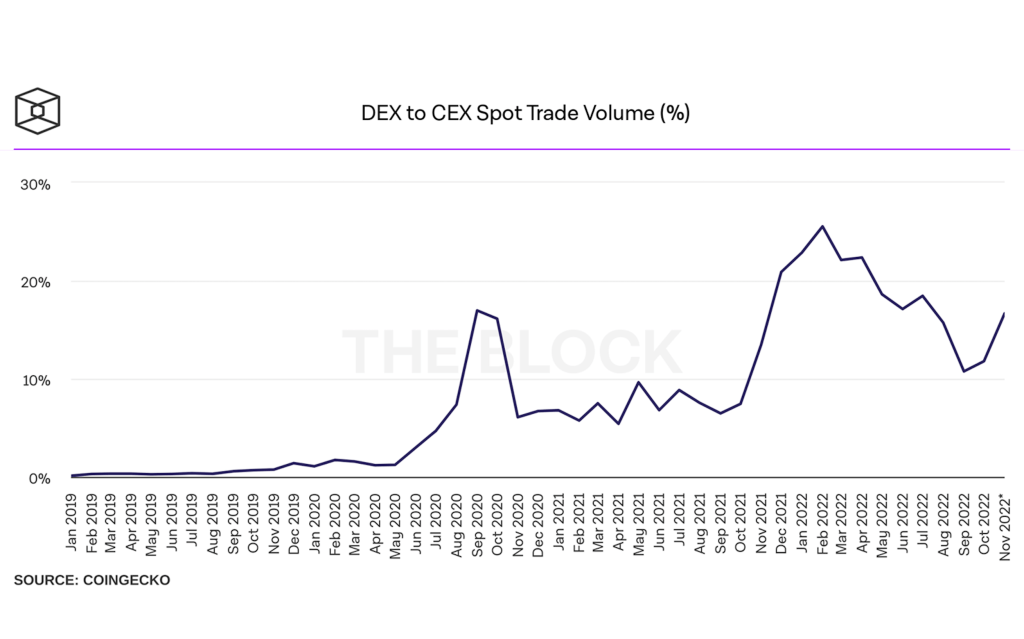
The chart above tracks the total trading volume of DEXs as a percentage of the total trading volume of CEXs. And while that number’s been trending upward since 2019, it’s seen a hefty jump over the last few months following the collapse of other centralized crypto platforms like Celsius and Voyager.
While CEXs have to be audited and regulated to keep their customers’ trust, DEXs run entirely on the blockchain. Their transactions are automatically executed through smart contracts, and they’re all publicly recorded. For savvy crypto users, that can bring a lot of comfort.
Of course, centralized exchanges aren’t all bad, and some could even end up stronger (Coinbase) after all of this. And DEXs aren’t exactly risk-free either, as there could be unseen bugs in the smart contract code that’s used to run them. So if you’re going to dabble in DEX tokens as a long-term (and likely very volatile) investment, start by researching the tokens of the biggest DEXs, and then spread your risk among a few of them if you invest. According to DeFiLlama, Uniswap (UNI), PancakeSwap (CAKE), and Curve Finance (CRV) are currently the biggest DEXs by trading volume and total assets held.
 The GillPower