
US stocks are already near record highs, but the special relationship between the S&P 500’s valuation and inflation – known as the “rule of twenty” – could be poised to send shares even higher next month…
What is the “rule of twenty”?
The rule of twenty – which was developed by strategist Jim Moltz in the early 1980s – suggests you can calculate the fair value of the S&P 500’s price-to-earnings (P/E) multiple by subtracting US consumer price inflation from 20.
So in practice, June’s 5.4% inflation rate would make the S&P 500’s fair value P/E multiple 14.6x (20 – 5.4).

In reality, though, the key US stock market index is currently trading at 22x. That’s unusual: the rule of twenty has held up pretty consistently since the 1950s, save for a few periods like the dotcom bubble and, of course, right now.
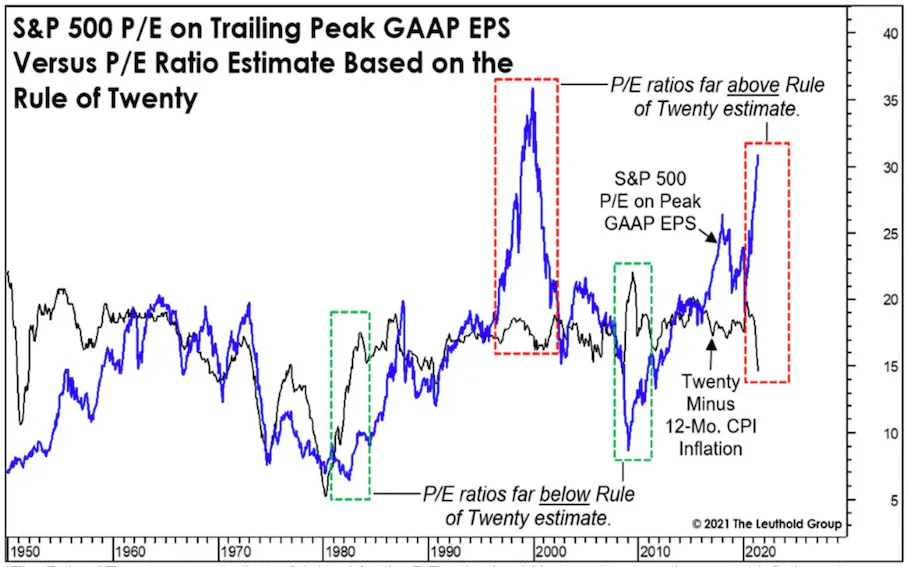
But there’s also a simple reason for the recent divergence: government and central bank support has boosted asset prices so much that they’ve barely corrected in the face of record-high US inflation.
Inflation, after all, has been climbing to record high after record high mostly because of “base effects”: that is, inflation was so low at last summer’s height of the pandemic that any comparison makes current inflation look high. That’s partly why the European Central Bank and Federal Reserve are so insistent that inflation will revert to more normal levels soon enough.
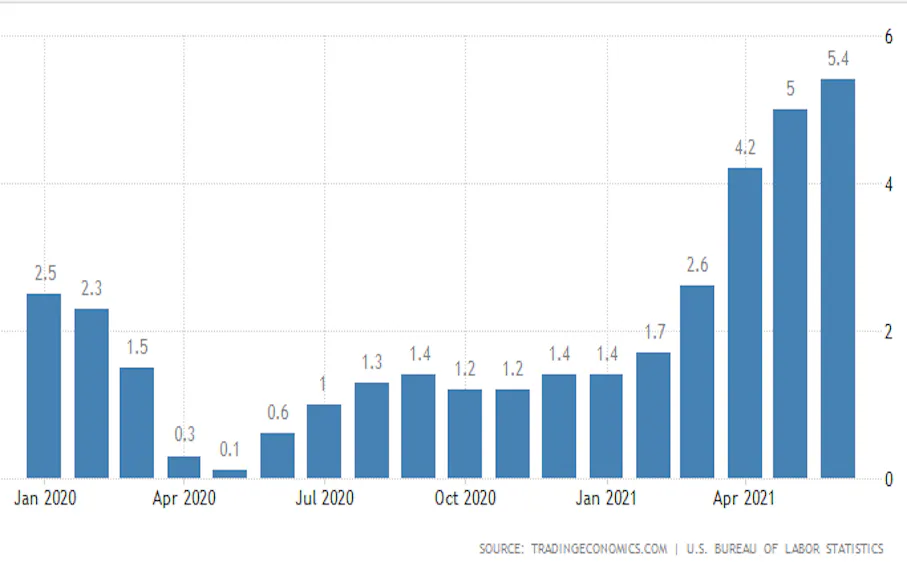
US consumer price inflation, year over year
So what’s the opportunity here?
The pandemic started to lift in July last year, which means that low “base effect” is starting to wear off: July’s inflation data – due on August 11th – is expected to show inflation beginning to moderate.
So let’s say inflation drops from 5.4% to 4%: the S&P 500’s fair P/E multiple would, according to the rule of twenty, rise from 14.6x to 16x – a 10% uptick. That’s still not on par with the 22x multiple US stocks are valued at right now, which means the rule of twenty still isn’t holding true. But even if it isn’t, the relationship it implies between inflation and valuation probably will (just like it seemed to do earlier this year). In other words, there’s still theoretically some upside to share prices if inflation drops off in July.
So if you’ve been looking at sky-high US stocks and want to take out some cash, or if you’re dollar-cost averaging, now looks like it could be a good time to throw caution to the wind (just a little bit, mind) and increase your allocation to US stocks ahead of the next inflation data release.
As for how to do that, the following exchange-traded funds (ETFs) give you low-cost access to the US market in slightly different ways:
- Vanguard S&P 500 ETF (ticker: VOO) tracks the S&P 500
- Vanguard Small-Cap ETF (ticker: VB) tracks an index of smaller US stocks, whose prices tend to move by more than large S&P 500 companies
- DIA SPDR Dow Jones Industrial Average ETF Trust (ticker: DIA) tracks the Dow Jones Industrial Average index, comprising 30 of America’s biggest and most stable companies
- iShares NASDAQ 100 UCITS ETF (ticker: CNDX) tracks the tech-focused companies in 100-strong Nasdaq 100 index
 The GillPower