
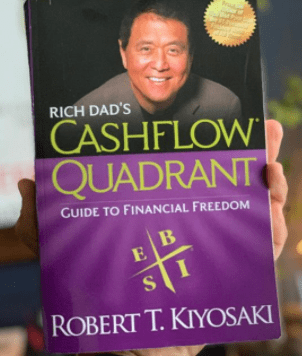
- The different ways in which we earn money can be divided into four quadrants: E,S,B and I. E- employee, S-small business or self-employed, B- big business owner, I-investor. All of these quadrants require different capabilities and personal characteristics. If you want to be financially free, then you’ll need to move from the E and S quadrants into the B and I quadrants. In short, from working to owning.
- Studying and working hard won’t get you to financial freedom.
- Many people still believe that working hard without investing can give you financial security this is because they have poor financial education.
‘My educated dad was a voracious reader of books, so he was word-smart, but he was not financially literate.’
Robert T. Klyosaki
5. Working hard and working smart are two different things.
6. Today, we live in what is roughly defined as the ‘Information Age.’ It marked the end of the ‘Industrial Age’. It was also the beginning of the end of for secure, unionised jobs and good government pensions. In today’s economy, we can’t rely on the government to look after us. We need to take our financial security into our own hands. If the government raises taxes to pay for welfare for promises, the ultra-rich will just escape to countries with lower taxation.
To achieve financial security throughout your life, you’d better move into one of the right-hand quadrants, B or I: Big business ownership or Investment.
Kiyosaki’s ‘rich dad’ had created a system of passive income; he’d entered the I quadrant early in life, and it shielded him through the rest of his days.
7. The four quadrants attract different types of people.
E quadrant- people who seek security and benefits, they choose contractual security.
S quadrant-self-employed or the owners of small businesses. These people like to be ‘their own boss’. When it comes to money, they don’t like having their income determined by others-if they work hard, they expect to be paid well. Conversely, if they don’t do a decent job, then they understand they’ll make less. They are often perfectionists- they believe that nobody can do a better job than they can. For them, independence is more important than money. They also fear of losing their independence.
The B quadrant- the large business owners. In many ways, they’re the opposite of those in the S quadrant. They like to surround themselves with smart people from all of the other categories. Their chief talent is delegating. Henry Ford was a classic example. He wan’t the most talented financial analyst or mechanical engineer, but he was brilliant at hiring others to do those things for him. Those in the B quadrant are able to leave their whole operation running while they do nothing. Instead, they oversee a system that continues to make money for them.
The I quadrant-the investors, the realm of the ultra-rich. And what characterises them is their ability to take calculated risks. Like gamblers, they aren’t afraid of volatility. But unlike gamblers, they like to research their risk. Embrace the danger of a financially volatile world, while also making sure to understand, better than anybody else, all of the risks involved. This is the key trait for anyone who wants to attain financial freedom.
The surest way to achieve financial freedom is to move into business ownership so you can invest. To become rich, it’s important to accumulate capital. And the surest way to do that is through investing- in shares, funds or property. But to invest effectively, you’ll need a ready flow of capital and time. And the best way to attain that is to set up a business that can earn money while you sleep, like Kiyosaki’s ‘rich dad’. Also, if you can make it in business, you’ll be well equipped to become a great investor. Instinctively, you’ll understand which business models will yield better, long-lasting investment returns.
8. There are 5 different classes of investor
- 0 financial intelligence level, these are the people who have nothing to invest. They get into more debt than their income allows for.
- Savers-are-losers level. A financially illiterate level. The accepted wisdom has been that just saving money means financial security later on. But interest levels are very low in the modern economy, so there is very little return if you just park your money in a bank account. And as we saw with the 2008 financial crisis, those who’d saved their money in bonds–that is, government loans, packaged into retirement funds-often had their savings wiped out. Saving is not enough.
- I’m-Too-Busy Investor. These are people who simply hand over their money to a financial adviser.Though these investors are often more successful than the first two groups, they still run a great risk. As many found out after the 2008 crash, their ‘trusted expert’ was nothing of the sort, and they lost great chunks of their investments. This is because they entrusted their money to people who weren’t successful investors themselves. Rather, they were just employees at a financial advice firms.
- I’m-A-Professional Level. This is the first real kind of investor. These are people who educate themselves on investing, in stocks or real estate. And they do their own in-depth research. They’re more focused in their investments, and they develop a financial education that’ll serve them well throughout their lives. A financial education is itself a great investment.
- The Capitalist Level. The Warren Buffet level. First, you become a successful business owner, then you plow your capital into riskier investments. It’s the steepest mountain to climb. If building a business empire isn’t your ambition, then the ‘I’m-A-Professional’ investor level is more achievable.
‘My poor dad often said, ‘Investing is risky.’ My rich dad often said, ‘Being financially uneducated is risky.’
Robert T.vKlyosaki
9. Money provokes irrational feelings which we must overcome. Investing has the power to turn otherwise rational people into gibbering wrecks. It’s an emotional subject. But when it comes to money, it’s important that your logic triumphs over these feelings. Kiyosaki learned this early on. As he strove for financial success, he and his wife found themselves homeless, living out of their car. But rather than give in to justifiable fear and abandon their dreams, they knew that, if they kept to their path, they’d succeed. So they slowly and deliberately built a lucrative business. Four years later, they were millionaires.
10. To achieve financial success, take baby steps and keep the long-term in mind. To achieve financial freedom means embarking on a long journey, be wary of trying to get rich in the short-term. Nobody became rich and stayed rich through purely short-term thinking. Many of the greatest investors began small and worked their way up. Even Warren Buffett began selling chewing gum door-to-door. So, you must start small and set achievable goals. Don’t overextend yourself or your finances in the rush to get rich.
Invest in compound investment, you should also invest in your financial education. A good understanding of the stock market or the real estate sector can be much more useful than a risky investment portfolio.
11. To be a successful business entrepreneur requires: 1. ownership or control of system. 2. The ability to lead people.
‘Leadership, is the ability to bring out the best in people.’
Robert T. Kiyosaki
Trained in the technical skills necessary for becoming successful in business-technical skills such as reading financial statements, marketing, sales, accounting, management, production and negotiation. Throughout each lesson, he stressed that we needed to learn to work with and lead people. The rich dad always said ‘The technical skills of business are easy, the hard part is working with people.’
12. Financial security is having a secure footing on both sides of the Cashflow Quadrant. A big secret is that true investors make more money in bad markets, they make their money because the non-investors are panicking and selling when they should be buying.
‘I’m not afraid of the possible coming economic changes, because change means wealth is being transferred.’
Robert T. Kiyosaki
 The GillPower