
- Just like a detective, a successful investor does her homework and digs deep to get all the pertinent information before putting her money on the table.
- Smart investing involves much more thought and planning, and is ideally focused on the long term. Smart investors don’t seek quick profits but instead looks for companies with growth potential that over time will multiply an initial investment.
- Smart investors look for companies with potential that are nonetheless still undervalued, as such companies can, when the time is right, grow with such rapidity that an investor can double or even triple his initial investment.
- Companies with growth potential can be recognised by their common characteristics:
- Offer products and services that ideally could sustain high sales volumes for at least a few years.
- Companies with good growth potential also invest in research and development, to continue growing even when a current product line no longer offers opportunities for growth. For example, the previous Motorola, known for mobile phones, used to produce televisions and radios. But management had the foresight to harness the company’s technical skills and experience to enter the two-way communication business, and continued to grow sales while other TV manufacturers’ sales flatlined.
- Have a solid management team and good employee relations. (Get such information from HR). Don’t invest in a company whose employees are too busy squabbling to be productive, and whose executives can’t inspire solidarity or a shared vision in the workforce.
5. When considering a company’s investment potential, you’ll want to collect detailed information about the company from every possible angle. Of course, you could easily track down a trader and ask her which companies she would recommend investing in. However, there’s no guarantee that she’ll give you accurate information, because traders have to protect their own interests. Instead, employ the scuttlebutt method: dig for information from every possible source. Contact vendors, customers, former employees and research scientists or executives in trade associations. As long as you ensure that you won’t make the information public or out your informant. Contacting a few of the company’s competitors could also yield surprisingly accurate and detailed information.
6. The scuttlebutt method is accurate, yet time-consuming. To avoid wasting any time, choose the companies you wish to research very carefully. If you read in the newspaper, for example, that a company’s manager is resigning because of some questionable dealings, then you won’t want to waste your time on that company.
‘The successful investor is usually an individual who is inherently interested in business problems.’
Philip Fisher
7. Once you’ve identified a company with good long-term growth potential, is it time to buy? The simple realisation about the stock market’s irrationality can help you earn extraordinary profits. Companies with potential to grow are often innovators, and they’ll inevitably run into bumps along the road. Consequently, the financial community will undervalue the stocks of these companies. For example, imagine you’ve found a widget manufacturing company with huge growth potential. At first, the hype surrounding the company causes the stock price to rise. However, a problem soon appears: the casting mold for the company’s widgets were improperly sized. Now everyone thinks the product is a flop; and the stock price falls. This presents the perfect time for you to buy in cheaply, to profit when the company ultimately fixes its problems.
8. Be confident in your choices. Don’t give in to doubt, or follow the investor herd mentality. Don’t hesitate once you’ve identified a company with profit potential. Often this hesitation derives from the whims of the crowd. If no one else is jumping on a stock, couldn’t that mean that it isn’t really that valuable? Surely, it’s scary to buy when everyone else is selling! But if you truly believe a company has potential, then take a deep breath, and buy. Besides, you really don’t want to be buying what everyone else is buying. At that point, the stock will be too expensive to be a truly great investment.
9. Once you’ve found a good investment, you should hold on to it. From a business perspective, there are only three valid reasons to sell a stock:
- You misjudged the company’s growth potential.
- Your judgement was sound, but the company conditions changed.
- You’ve invested in a middling stock in the near-term to keep you busy while you search for an amazing investment.
Any other reasons, such as making money quickly or following the crowd, can only harm you. A company with huge growth potential can never be overvalued!
‘If a job has been correctly done when a common stock is purchased, the time to sell is almost never.’
Philip Fisher
10. If you are a conservative investor, you want a strong company that still has the potential to grow. Keep your eye out for large, established companies that have a proven track record of profitability. The company must simply be able to grow and develop. Otherwise it will eventually be outpaced by more agile competitors.
11. A company that is both strong and able to grow demonstrates these 4 major characteristics:
- The company’s production methods are low cost, such that it can continue earning profits even when prices rise, through inflationary periods or market crashes.
- The company is well organised and effective in its market, meaning it can actually deliver its products and services.
- The company has an outstanding track record in research and technical development, allowing it to continue innovating and improve upon its products and services.
- The company needs to demonstrate financial know-how. Be capable of allocating resources only to initiatives with profit potential, and have a good eye for warning signs that indicate it’s time to move on.
- Important to examine a company’s employee base and learn about how the company treats them. There are two main reasons for this strategy: 1. a company’s growth potential is entirely dependent upon employees who put into motion the company’s strategy. Indeed, all of a company’s advantages are the direct result of work performed by its employees. 2. To foster innovative technical development, for example, a company needs devoted, ambitious research and development teams. To ensure production methods are low cost, a company needs a bright manager who is always on the lookout for gains in efficiency. 3. How a company treats its staff can help you figure out just how productive and effective that company is overall. People don’t deliver the best results when they’re mistreated; yet companies succeed when employees are valued. By looking at a company’s human resource and management policies, you can get a better idea of how a company is run and better judge its long-term potential. Look, for example, at the way the company handles promotions. If they rarely promote from within and instead prefer to hire from outside the company, then this is a strong indication that the company isn’t developing potential through training. This is a red flag that the company does not handle its human resources wisely, and is therefore not the kind of company in which you would want to invest. The same applies to management’s ability to work together as a team. If a company manager seems to think he’s running a one-man show, how can he be expected to manage efficiently as the company grows? A healthy company is that all managers cam effectively delegate responsibility.
12. You want to find a company that will be profitable in the long term, but how can a business ensure long-term profits? In short, by being better than the competition!
A company’s long term profitability hinges upon its ability to do or create something that competitors can’t, lest the competition steal its market share.
One way to ensure market dominance is through scale. A large producer can produce more than a small competitor can, and at a lower cost.
Another way to ensure a company’s market position is by creating technical developments that can’t legally be copied by other companies, due to patent or copyright.
13. If the company you’re interested in needs to raise equity shortly, your shares might dilute. So, it’s smartest to buy stocks in a company that you know can finance its growth on itself-due to sufficient reserve funds or timeproof borrowing capacity.
14. Don’t buy into promotional companies. Avoid companies that haven’t enjoyed ‘at least two or three years of commercial operation and one year of operating profit.’
15. The marketability of stock shouldn’t affect your judgement.
16. Don’t buy based on the annual report. Annual reports are usually promotional pieces written by PR (Public Relation) managers. Don’t trust them.
17. Don’t assume a lack of upside because of a stock’s high P/E. Don’t assume that the high price at which a stock may be selling in relation to earnings is necessarily an indication that further growth in those earnings has largely been already discounted in the price.
18. When your ‘scuttlebutt’ research says that a stock is the right one, buy it immediately: don’t wait for that ‘magic price’ that might never arrive.
19. Don’t overstress diversification. True, it might not be a good idea to put all your eggs in one basket, but it is even less smart to invest in 50 businesses: there’s no way you can learn enough about all of them to make adequate assessments about their prospects.
20. Past performance is not indicative of future results. So, pay little attention to information of this kind- and related false knowledge.
21. Don’t follow the crowd. Markets are not rational. So, avoid the herd mentality and all the get-rich fads and styles out there. Stick to the ‘scuttlebutt’ and the 15 points. And stay conservative.
To conclude, the 4 dimensions of a conservative investment:
- Marketing. Conservative investors must have evident superiority in ‘production, marketing, research, and financial skills.’
- People. There must be evidence of committed management and good leadership, as well as all-round positive company culture.
- Uniqueness.
‘There are certain inherent characteristics that make possible an above average profitability for as long as can be foreseen in the future.’
Philip Fisher
The last dimension is valuation. Whether the price of the stock is sensible in the context of its relative prospects.
The risk of an investment is the result of the relationship between the first three dimensions and the fourth dimension. Naturally, the lower it is, the more sensible the investment and the more guaranteed the profits in the long run.
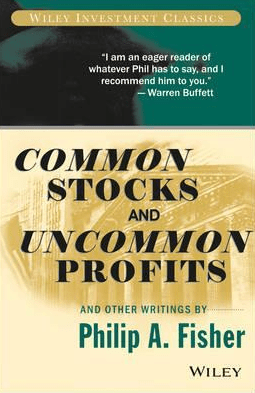
Many have described Buffett’s stock-picking methods as a combination of Benjamin Graham’s value investing and Philip Fisher’s 15 pointers.
Emotional poise can be as valuable as a wise portfolio manager because it can help you earn a more productive return on investment when other investors are scared away by temporary losses.
 The GillPower