
- Charlie Munger’s strong work ethic and philanthropic attitude (formed from his early grocery job where he worked 12 hours shifts without rest). He always educates his children that ‘get the job done or suffer the consequences.’
- Great investors are not specialists, but generalists, possessing multidisciplinary knowledge, giving them multiple ways of thinking and countering problems. Take Munger’s example, he was trained in physics, law, and was a pilot; these all facilitated his afterwards management of Berkshire Hathaway. Multidisciplinary knowledge give you diverse mental models and tools. (I will explain it in the later pilot example.)
- Stay principled, be honest. Charlie highly respected investment morality, avoided doctoring books to make investment look healthier or conducted any insider trading like many Wall Street crooks, even though unethical practices become a prevalence. Charlie never let tax evasion happen, even though this has become a de rigueur for companies like Amazon etc. Munger completely sticks to the law.
‘Once you’ve done something bad, it’s easy to take the next step and then you are a moral sewer.’
Charlie Munger
His strict morality awareness and zero tolerance of breaking the law; he despised ‘creative accounting’ or any unethical practices e.g. accounting for derivatives- inflating books based upon values from speculation. This attitude and insistence of bottom line led his successful avoidance of consequences of 2008 Financial Crisis.
4. Learn from mistakes and not afraid of changing minds. If you find a new idea more useful, discard the old ones immediately. Welcome criticisms. ‘Only a very confident person is able to freely admit when they’ve made a mistake.’
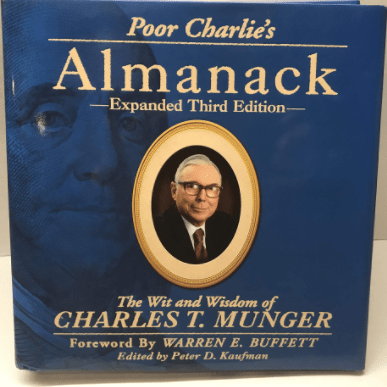
5. Investing- patience and focus. In his book, Munger emphasised quality over quantity- He prefers investing big in a small range, owning a majority stake (which can influence companies’ future) to diversification (mixtures of over-performed and under-performed, investing small in a wide range).
6. Learn from pilot training:
- Think out of box.
- Forced to apply training in practice.
- Update their knowledge from lifelong learning.
- Respond to problems with mental agility.
- Make a mental inventory of the problem and possible causes and solutions, considering counter-intuitive possibilities.
7. Recognising your own psychological limitations; this including starting to: 1. Analyse the situation objectively, avoiding being manipulated subconsciously. 2. Recognising your own ‘competance circle’ to determine your investment e.g. Munger and Buffett refused to invest in ‘high tech’- since they didn’t know much about this sector-closed off lucrative investment but avoided devastating losses.
Of course you can broaden your competence circle but in the short term…
8. The renowned ‘value investing’ pioneered by Benjamin Graham: calculate the value of the company, dividing by the number of shares available, if the shares were on the market for no more than a fifth of the company’s actual value-a worthwhile investment.
The aforementioned is traditional, in practice, look at:
- The management, it’s policies, the manager.
- How the company’s product is currently placed in the market. e.g. strong brand recognition, established international distribution network etc.
- The most surefire way- a company that is poised to surf the wave of success. (What is now trending) e.g. in the past, Microsoft, personal computer boom.
 The GillPower